
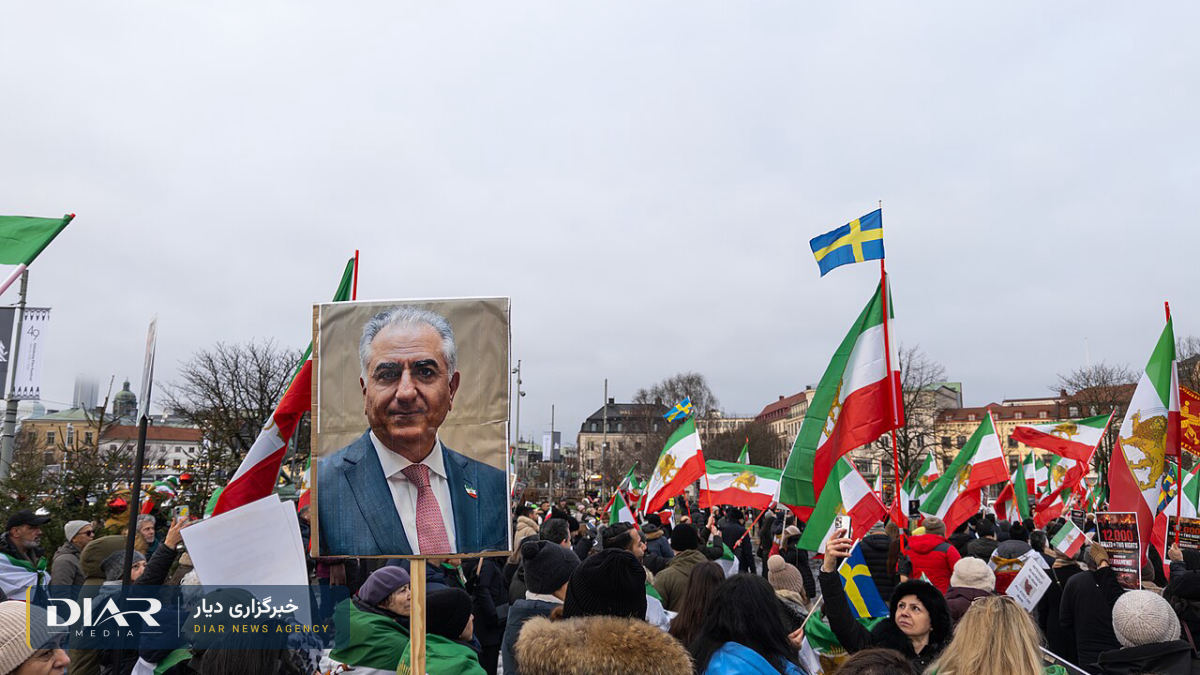
At a time when Prince Reza Pahlavi is more visible on the international stage than ever, a new voice is being heard among some accounts and figures who call themselves constitutionalists: a voice that outwardly defends "Iran's integrity" but in practice repeats what the People's Mojahedin Organisation (MEK) and the Islamic Republic's propaganda apparatus have said against the Pahlavi family for years. In the assessment of DIAR's analysts, this alignment cannot be dismissed as a mere difference of political taste; it is a pattern with a clear precedent in Iran's modern history.
From support to open hostility
Part of this current consists of people who until recently presented themselves as supporters of Prince Reza Pahlavi. In the assessment of DIAR's analysts, some of them at one point sought to work with the Prince's team, and when that cooperation did not continue, they turned personal disagreements with team members into open hostility towards the Prince himself. A shift from support to hostility, without any change in Prince Reza Pahlavi's positions, shows that this group's motives are tied more to personal standing than to principle.
The pattern is familiar to observers. In recent weeks, the Rajavi camp's campaign against the Belgian parliament's invitation to Prince Reza Pahlavi and a protest letter from a group of organisations to Belgium's foreign minister showed that every step the Prince takes on the international stage meets a coordinated reaction from his opponents. Now the same narratives are being heard from people who label themselves constitutionalists.
Praise for the IRGC after the Dey massacre
The most worrying part of this discourse is its tone towards the Islamic Revolutionary Guard Corps (IRGC). Some of these same figures have praised the IRGC in comparison with other regime forces and have even described Masoud Pezeshkian as a "guardian of the land of Iran". Yet the IRGC was the main force behind the crackdown on the Dey uprising, and the blood of those who fell on 8 and 9 January is still fresh in Iranians' memory. DIAR previously reported that the Islamic Republic's network of proxy forces was also used in crushing the Dey uprising.
Drawing a line between a "good IRGC" and a "bad regime", or presenting the Islamic Republic's president as Iran's saviour, is exactly the narrative the Islamic Republic needs to survive: one that says part of the power structure can be kept and Iran can be saved from within it. Iran's national revolution is built on the complete rejection of that structure.
"Iran's integrity" as cover for what aim?
Defending Iran's territorial integrity has been one of the foundations of the thinking of Prince Reza Pahlavi and his supporters. Using the banner of "Iranian integrity" to attack the Prince is therefore a blatant contradiction. In the assessment of DIAR's analysts, by highlighting secondary disagreements and creating new dichotomies within the ranks of the Islamic Republic's opponents, this discourse does what the MEK has done for decades: scatter the opposition's strength at the very moment when its unity matters most.
The MEK has a clear record: collaboration with Saddam Hussein during the Iran-Iraq war, a closed cult-like structure and a role in paving the way for the 1979 revolution. The alignment of any current that calls itself constitutionalist with that record raises serious questions about its intentions and direction.
The lesson of 1979
In 1979, a disparate coalition of Islamists, leftists and the MEK, focusing on attacking the Shah personally and the Pahlavi family, paved the way for a regime that later made victims of them too. Then as well, sowing division among national forces and turning small disagreements into great enmities played a decisive role. In the assessment of DIAR's analysts, today's pattern bears a meaningful resemblance to that experience: the same dichotomies, the same attacks on Pahlavi, and the same ultimate benefit for the regime that Ruhollah Khomeini founded.
Consequences for Iran's national revolution
Today the Islamic Republic is under the pressure of a blockade, an economic crisis and an internal power struggle, and above all it pins its hopes on divisions among its opponents. Every voice within the opposition that praises the IRGC or whitewashes regime officials, wittingly or not, feeds that hope. DIAR has also written previously about the silence of the monarchists' critics in the face of the Islamic Republic's warmongering.
The choice facing political activists is clear: stand with Iran's national revolution and the leadership of Prince Reza Pahlavi, or step onto a path that, whatever it is called, ends in the continuation of the very regime Iranians took to the streets against in Dey.
A constitutionalism that praises the IRGC and echoes the Rajavi line works, in practice, for the Islamic Republic.
Comments
No comments yet. Be the first.