
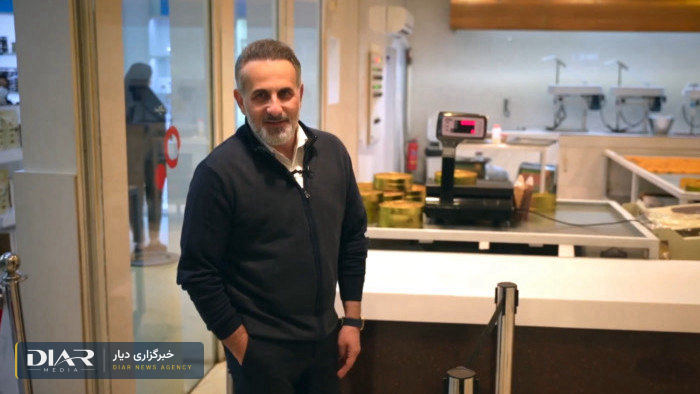
Ali Asghar Soltani, the general and revolutionary prosecutor of Qom, announced on Sunday 25 October 2026 that the movable and immovable assets of Sadegh Saedinia, manager of the Saedinia café chain, and in particular his cryptocurrency, have been seized and that other steps to confiscate his assets have also been taken. Saedinia is one of the entrepreneurs who sided with the protesters during the Dey uprising and has been in prison since then.
The move enforces a sentence upheld by the Supreme Court on 3 September 2026: 12 years, six months and one day in prison, confiscation of all movable and immovable property in favour of the state, and a two-year ban on working in the café business after his release. Earlier, the judiciary in Nowshahr had also announced the seizure of his assets in that city and the sealing of one of his cafés.
The charges: an Instagram story and closing the cafés
Sadegh Saedinia, son of Mohammad Saedinia, founder of the Saedinia confectionery and sohan business in Qom, was arrested after posting an Instagram story and announcing the closure of his business on 8 and 9 January 2026. All branches of the brand's cafés were sealed by judicial order, and his father was also arrested in connection with the same case.
Qom's Revolutionary Court heard his case on 17 May 2026. The charges the Islamic Republic's judiciary brought against him were "propaganda or media activity against national security", "propaganda activity against the system" and "operational action" in favour of groups the judiciary labels "hostile". The prosecution accused him of supporting strike calls, closing the cafés and encouraging staff to join the protests, and called him an "instigator" of the protests in Qom and the damage of those days.
In court, Saedinia rejected all these charges and said closing the cafés was not an act against the authorities. No independent evidence of a direct link between his actions and the damage in Qom has been published, and the full text of the verdict has never been made public.
Asset confiscation: a new tool of repression
Saedinia's case is an example of a pattern the Islamic Republic has adopted since the Dey uprising: combining long prison terms with the full confiscation of assets, so that every shopkeeper and entrepreneur who considers standing with the people knows the price is the destruction of their entire economic life. The same approach can be seen in the security vetting of powers of attorney issued by Iranians abroad, which has exposed opponents of the regime to the threat of asset confiscation.
After the shops were sealed, his father wrote a letter calling the closure a "mistake" and apologised to the Islamic Republic's leader, a letter many users regarded as a forced confession. Even so, the pressure on the family did not stop, and the order to confiscate the son's assets has now been enforced.
By confiscating all of Sadegh Saedinia's assets, the Islamic Republic has turned an entrepreneur's support for the Dey uprising into a case meant to intimidate every merchant.
Comments
No comments yet. Be the first.