
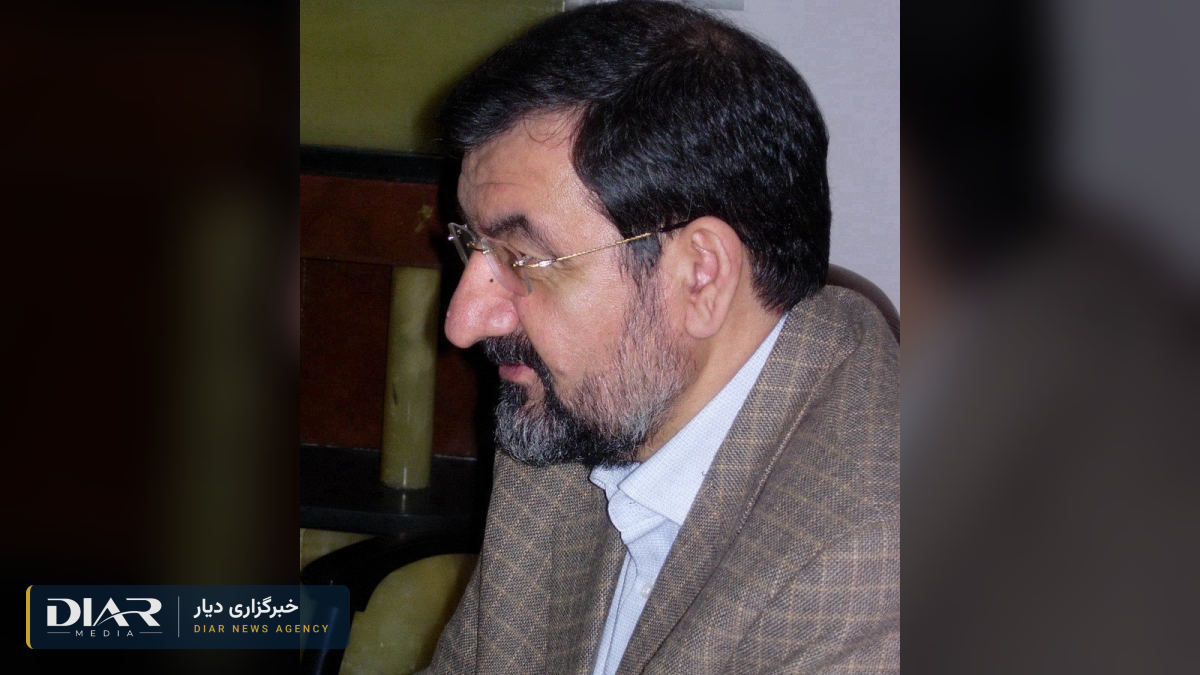
The rise of Mohsen Rezaei, a former commander of the Islamic Revolutionary Guard Corps (IRGC), to secretary of the Islamic Republic's Supreme National Security Council cannot be seen as a simple administrative reshuffle. In the assessment of DIAR's analysts, the appointment is the direct result of a process that over the past two years removed the IRGC's top tier of commanders and cleared the field for an older, more war-minded generation; a generation that, faced with the regime's successive crises, proposes war instead of politics.
The emptying of the IRGC's top ranks
In the 12-day war of June 2025, Hossein Salami, the IRGC's commander-in-chief, Mohammad Bagheri, chief of staff of the armed forces, and Amir Ali Hajizadeh, commander of the IRGC Aerospace Force, were killed. In this year's war Ali Larijani, then secretary of the Supreme National Security Council, was also killed and Mohammad Bagher Zolghadr took his place. Zolghadr stepped aside a little over four months later, and on 9 August 2026 Mohsen Rezaei replaced him, both by decree of Masoud Pezeshkian and as Mojtaba Khamenei's representative on the council.
Many observers analyse these successive eliminations in the context of Israeli and American military and intelligence pressure. But their consequence inside the regime has received less attention: as the top ranks emptied, figures who had been on the sidelines for years have returned. Rezaei was commander-in-chief of the IRGC for 16 years from September 1981, during the Iran-Iraq war, and later ran for president several times and lost.
From the negotiating table to the language of threats
Hamidreza Azizi, a researcher at the German Institute for International and Security Affairs, described the appointment at the time as a sign of the consolidation of power by veteran security figures and of the advance of hardliners, and saw it as a counterweight to Mohammad Bagher Ghalibaf, the speaker of parliament in charge of negotiations with the United States. Saeid Golkar, another analyst, spoke of the IRGC's role in key decisions and a possible rivalry between Rezaei and Ghalibaf.
Rezaei's conduct since his appointment has confirmed this assessment. In September he set out the Islamic Republic's conditions for ending the war as an end to the war on all fronts, the release of frozen assets and an end to the naval blockade, while saying that Tehran was ready for a decisive war. Some time later he said the Islamic Republic would no longer respond to the United States and called Washington's reply insufficient. Last week the IRGC also announced that it had abandoned its defensive doctrine and turned to offence.
War instead of politics
The thinking Rezaei represents can be summed up in one sentence: enough negotiating, it is time to act. A regime whose economy is paralysed by a naval blockade, whose land borders with Iraq and Pakistan are closing one after another, and whose own head of government speaks of the "worst" state of neither war nor peace, shows no way of solving its crises. Instead of practising politics, it drags out negotiations and sees the threat of a wider war as its only remaining tool.
In the assessment of DIAR's analysts, it is precisely this choice that brings the end of the Islamic Republic closer. The war the regime is accepting is exactly the path that has worn down its military, economic and political strength and removed its commanders one after another. Every new round of conflict knocks out another part of the power structure and at the same time separates the people further from the regime.
What it means for Iran
For Iranians, the rise of a figure like Rezaei means a regime that pays the price of its survival with the lives and livelihoods of the people. For Iran's national revolution, this process is another sign that the Islamic Republic has lost the capacity for reform and politics and relies on force alone. A regime that is unable to solve its crises and sees war as the solution has chosen the very path that leads to its own collapse.
Mohsen Rezaei's appointment shows that, after losing its senior commanders, the Islamic Republic has put war in place of politics.
Comments
No comments yet. Be the first.