
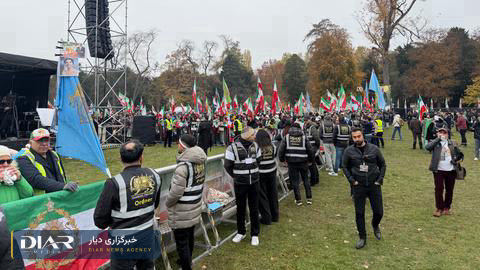
The rally of Prince Reza Pahlavi's supporters in Frankfurt's Ostpark on Saturday, 7 November, was more than a show of numbers. According to DIAR writer Jalal Jannati and the account of a compatriot who attended, many veiled women were in the crowd and were welcomed by other participants with flowers and respect. In the assessment of DIAR's analysts, this simple image calls into question one of the Islamic Republic's most persistent propaganda narratives about Iran's national revolution.
The narrative the Islamic Republic builds
For years, the Islamic Republic's propaganda machine and its allies online have tried to portray supporters of the monarchy as a movement hostile to the religious beliefs of part of society, one that would push religious Iranians aside if it won. The aim of this narrative is clear: to frighten the part of society that holds to its faith but has broken with the Islamic Republic, and to keep it on the regime's side, or at least silent.
The narrative grew louder after the Dey uprising, when Prince Reza Pahlavi's name and the Lion and Sun flag became the main symbols of the protests in cities across Iran. A regime that can no longer claim the support of the majority is trying to build a religious divide among its opponents.
What was seen in Frankfurt
24,000 people had registered for the Frankfurt rally, and Iranians from cities and countries across Europe attended. In such a crowd, veiled women standing beside unveiled women, young and old people, and families of many backgrounds showed a picture of Iranian society that the Islamic Republic has spent four decades trying to tear apart.
In this scene, the way people were treated matters. In Jannati's assessment, these compatriots were at the rally in complete safety and freedom, and the warmth and respect of the other participants defined their place. He sees the scene as a practical answer to anti-national propaganda and says tomorrow's Iran belongs to all Iranians whose hands are not stained with the people's blood and property.
Prince Reza Pahlavi's position
This picture matches what Prince Reza Pahlavi has said many times. He speaks of a secular, democratic Iran in which religion is separate from the state and every citizen is free to choose their dress and beliefs: neither compulsory hijab nor a ban on hijab. After receiving the Freedom Prize, he stressed again in his Frankfurt speech that Iran's future will be decided by the free vote of the people.
In this view, separating religion from the state does not mean hostility to religion. The compulsory hijab that the Islamic Republic has imposed through morality patrols, fines, arrests and violence has above all damaged the standing of the hijab itself in society. Women who freely choose their dress and stand beside others at a rally for Iran's freedom show most clearly the difference between personal belief and state religion.
The free presence of veiled women at the Frankfurt rally showed that Iran's national revolution draws the line between Iranians not by belief, but by complicity in repression.
Why it matters for the national revolution
The Islamic Republic needs fear of the future to survive: fear of the country breaking apart, fear of chaos, and fear of revenge among part of society. Every scene that shows these fears to be baseless shrinks the regime's base. The Frankfurt rally, over which the Islamic Republic's threats even cast a shadow, was such a scene.
The standard DIAR's writer puts forward is a clear one: not dress or belief, but each person's role in repressing and plundering the people. On that basis, religious Iranians who have broken with the Islamic Republic not only have a place in tomorrow's Iran, they are part of the force of the national revolution. Frankfurt's message to this part of society was that their place in the ranks of Iran's freedom is secure and that they are welcomed with respect.
Comments
No comments yet. Be the first.