
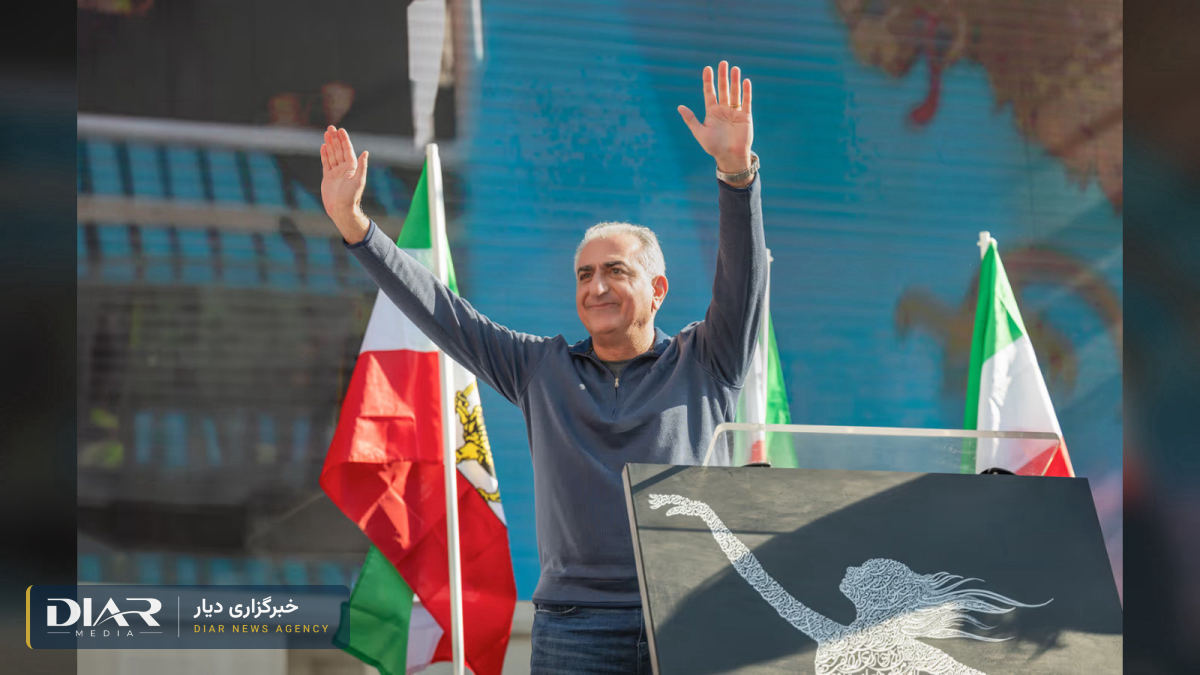
In recent months, every time Prince Reza Pahlavi's name tops the news, a wave of simultaneous accusations is launched against him: one day he is said to have "come to terms with the IRGC", the next to have "made a deal with America" and the day after to have "struck a bargain with Israel". In the assessment of DIAR's analysts, setting these claims side by side reveals above all their internal inconsistency, and exposes a political phenomenon: anti-Pahlavism as the only common ground of currents that agree on nothing else.
Accusations that contradict each other
A force accused at the same time of compromising with the Islamic Revolutionary Guard Corps and with the IRGC's enemies does not fit the simple logic of politics. Nor do these accusations come from a single source. Some of them come from survivors of the generation of the 1979 revolution who have still not revisited their own account of that year; some from the MEK (People's Mojahedin) and leftist groups, including the Fedaian, whose cooperation with the Islamic Republic in its early years and the Mojahedin's alliance with Saddam Hussein's Iraq are no secret; and some from separatist groups that see any plan for a united Iran as a threat to themselves. To this list must be added anonymous online networks whose job is to multiply these same narratives.
The root of the charge of "compromise with the IRGC" is in fact Prince Reza Pahlavi's repeated calls to the military and security forces, urging them to stop the repression and join the nation. Calling an appeal to break with the regime a compromise with the regime is a blatant distortion of a well-known strategy in transitions from dictatorship. The Prince has also said many times that he has never asked any foreign government to support him as a person, and that he sees his role as preparing the ground for a democratic transition that leaves the choice of Iran's future political system to the vote of Iranians.
The Islamic Republic's courts have given the answer
The clearest answer to the claim of a compromise comes from the Islamic Republic itself. Just this Monday, 26 October, the Revolutionary Court of Mashhad sentenced Hassan Golshan-Nejad, a protester of the January uprising, to death, and "taking part in Reza Pahlavi's call" is listed among the charges against him. A day earlier, the judiciary indicted Saeed Shakiba, a satirist and voice actor, on the charge of "supporting Pahlavi". A regime that treats answering a political figure's call as a crime worthy of execution has made no pact with him; it sees him as its most dangerous rival.
Fifty years of anti-Pahlavism and its result
For nearly five decades the Islamic Republic has put every tool it has to this purpose: oil revenues, its propaganda machine, school textbooks, lobbies that worked for years in Western capitals in favour of a policy of appeasement, and finally the force of arms against the nation. In the assessment of DIAR's analysts, this road has been travelled to its end and has reached a dead end. The slogans chanted in Iran's cities during the January 2026 uprising, the Lion and Sun flag at rallies of Iranians around the world, and the honouring of the memory of the Pahlavi kings among a generation that never saw that era, show that this propaganda has not had the effect on society that the regime wanted.
The currents that today follow the same path of anti-Pahlavism are therefore, in practice, reproducing the narrative of a regime that is itself collapsing. That narrative no longer finds buyers in Iranian public opinion.
A pact with the nation
The conclusion is that the contradictory accusations against Prince Reza Pahlavi say less about him than about his critics' inability to offer the Iranian nation an alternative. The only pact visible in his political record is a pact with the Iranian nation: a transition to a free, secular and democratic Iran whose destiny is decided by the people's vote. For Iran's national revolution, recognising this propaganda pattern and answering it with facts is part of the struggle against the Islamic Republic.
A regime that treats answering Prince Reza Pahlavi's call as a crime worthy of execution has made no pact with him.
Comments
No comments yet. Be the first.