
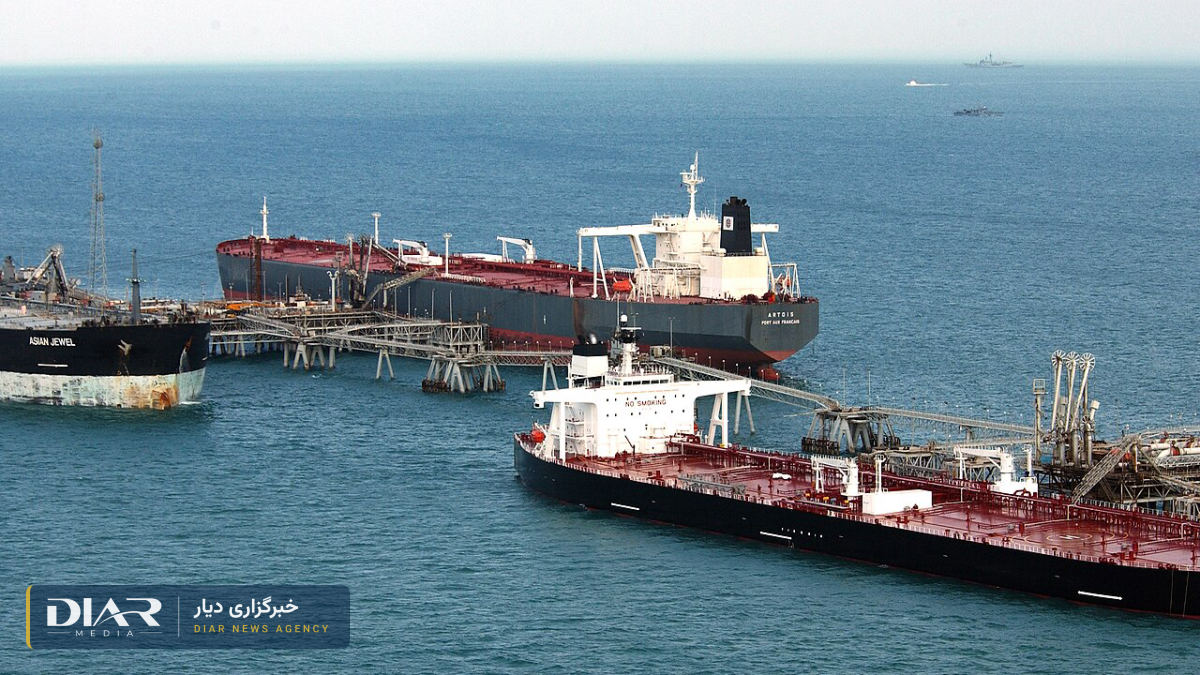
Persian Gulf oil exports rose above their pre-war level in the week to 18 October, despite a new wave of attacks by the Islamic Republic on ships in the Strait of Hormuz. According to data from the commodity tracking company Kpler, average Middle Eastern oil exports via the Strait of Hormuz and alternative routes reached more than 24 million barrels a day that week, compared with a pre-war average of 23.3 million barrels.
According to Kpler, the flow of oil through the Strait of Hormuz itself, together with ship-to-ship transfers in the Gulf of Oman, was about 14 million barrels a day, or 82 per cent of the pre-war level. From late August to late September, about 40 per cent of the crude exported by Persian Gulf countries other than the Islamic Republic reached the market without passing through the Strait of Hormuz, via pipelines in Saudi Arabia and the United Arab Emirates; before the war this share was 17 per cent.
A US-backed shipping mechanism
Tankers load in the Persian Gulf, switch off their positioning systems, pass through the strait and hand over their cargo near the coast of Oman to ships bound for distant markets. US air cover along the Omani coast protects part of this route. Brad Cooper, commander of CENTCOM, has said US forces helped export more than 100 million barrels of the region's oil in seven days and that control of the Strait of Hormuz is in the hands of the United States and its partners, not the Islamic Republic.
Hamad Hussain, senior economist at Capital Economics, said this mechanism is now established and that the Islamic Republic would have to act more aggressively to regain its former control.
High freight costs and IRGC attacks
This recovery is not without cost. According to Kpler, the freight rate per barrel on very large crude carriers from the Persian Gulf to China has reached about 37.4 dollars, close to a record, and war-risk insurance has risen from less than three per cent of a ship's value to up to 10 per cent. Crews of ships entering the Persian Gulf are offered two to three times their usual wages. Brent crude reached about 108 dollars on Tuesday, 20 October.
About 30 attacks on ships in and around the Strait of Hormuz have been reported this month. In addition to missiles and drones, the IRGC has turned to guerrilla methods such as spotting from fishing boats; among them was a grenade-launcher attack from a small boat on the tanker Loyalty on 16 October, while it was carrying two million barrels of Iraqi oil. DIAR had earlier reported on the targeting of ships' engine rooms in the Strait of Hormuz.
The Islamic Republic's oil under blockade
By contrast, the Islamic Republic's own oil exports have fallen almost to zero under the US naval blockade. The regime that had turned the Strait of Hormuz into a tool of pressure on the world now sees its neighbours selling their oil while only Iran's oil remains stuck behind the blockade.
Persian Gulf oil exports have passed their pre-war level despite IRGC attacks, and the Hormuz leverage has been blunted for the Islamic Republic.
Comments
No comments yet. Be the first.