
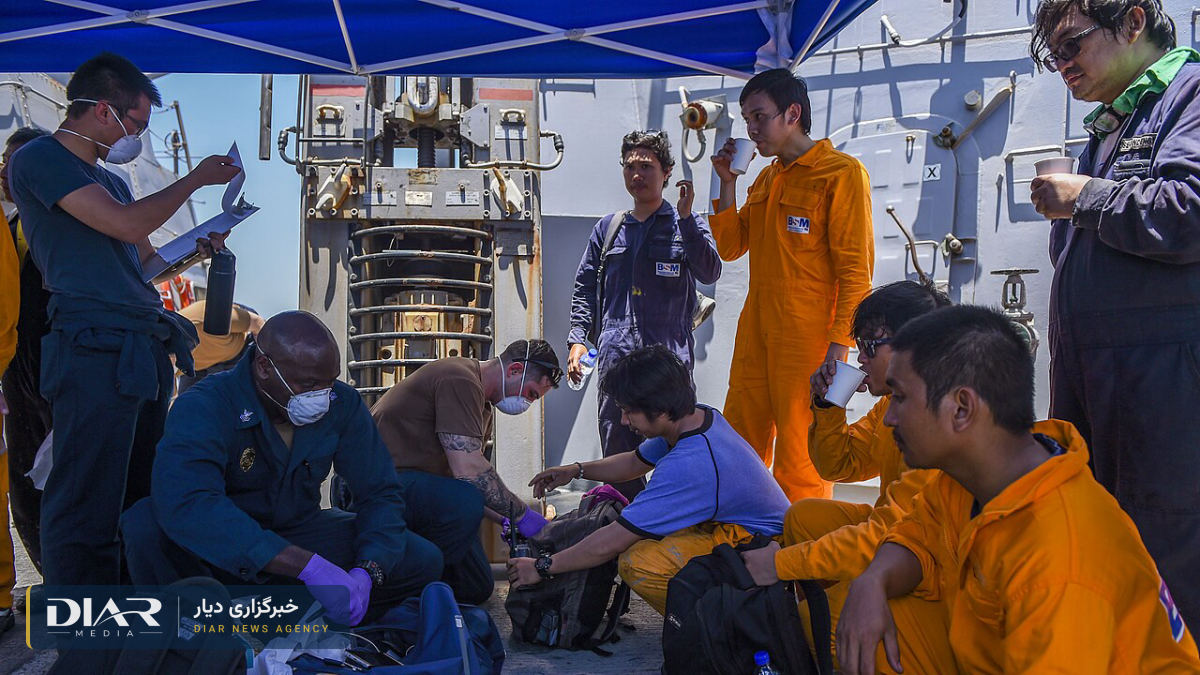
The Islamic Republic's attacks on merchant ships in the Strait of Hormuz and surrounding waters have become both more frequent and more destructive in recent weeks. According to warnings from regional maritime groups and maritime security consultancies, at least 23 incidents of attacks on ships in and near the Strait of Hormuz were recorded in the first two weeks of October (1 to 14 October 2026), and in at least five cases a ship's engine room was directly hit.
A hit on the engine room can cause fire and a complete loss of a ship's power and propulsion, sometimes taking it out of service for months. No attack on an engine room had been recorded from late August to late September, and before that at least seven non-Iranian ships had suffered such damage. At least two of the ships recently hit sank last week, among them a container ship in the Strait of Hormuz, after whose sinking Pakistan's hydrographic office warned of drifting containers in waters near the United Arab Emirates.
Missiles instead of drones; danger to crews' lives
According to shipping and maritime security officials, the Islamic Republic is increasingly using missiles instead of drones in its recent attacks. Infrared-guided missiles home in on the hottest part of a ship, the engine room, and carry much heavier warheads. These officials say it cannot yet be said with certainty that Tehran is deliberately aiming only at engine rooms.
Philip Belcher, marine director of Intertanko (the International Association of Independent Tanker Owners), attributed the increase in engine-room damage to the rising number of attacks. Jakob Larsen, head of safety and security at BIMCO, the largest international shipping association, warned that an attack on a ship's engine room or bridge puts the crew at very serious risk of death. The Joint Maritime Information Center (JMIC) has also reported that in one recent attack the bridge and crew accommodation of a bulk carrier were hit directly. The United States, too, has targeted engine rooms to disable Islamic Republic ships while enforcing its naval blockade.
Mine claim and CENTCOM denial
The IRGC claimed again on Tuesday, 20 October, that several tankers had hit mines in the south of the Strait of Hormuz; a spokesman for US Central Command (CENTCOM) called the claim false. State media also reported an explosion and fire on a supertanker carrying more than two million barrels of oil, without naming the ship and without any independent body confirming it. DIAR had earlier reported a similar IRGC claim about a tanker hitting a mine.
These attacks continue as Islamic Republic officials have called attacks on ships a tool of pressure on the US election, and Marco Rubio, the US Secretary of State, compared this method to Nazi Germany's U-boats. Analysts at Oil Brokerage said in a note that in a region where few owners are willing to send ships, a hit on any supertanker has a serious effect on the market. Nevertheless, Chris Wright, the US Energy Secretary, has said the region's oil shipments have reached about 80 per cent of normal levels, and preliminary data from Kpler show the seven-day average of Middle Eastern oil exports slightly above the pre-war level.
With missiles that home in on the hottest part of a ship, the Islamic Republic is targeting both crews' lives and the world's energy security.
Comments
No comments yet. Be the first.