
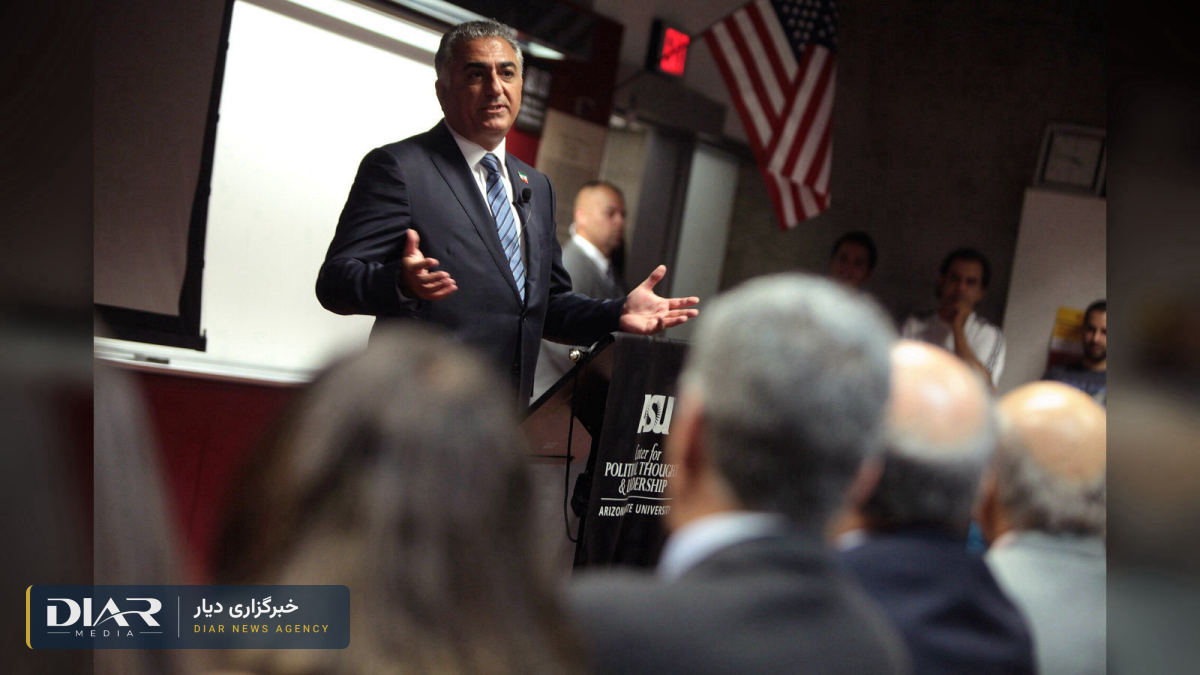
The news Yasmine Pahlavi announced on Friday, 6 November, goes beyond the cancellation of a speech. According to her, Frankfurt police told Prince Reza Pahlavi that, because of the Islamic Republic's threats of violence against the crowd, he cannot attend or speak at his supporters' rally on Saturday. DIAR has already reported the details of this decision. The central question is whether threats and intimidation can decide, in a European democracy, who has the right to speak and who must stay silent.
At the time of writing, Frankfurt police had given no public explanation of the decision. If Yasmine Pahlavi's account is confirmed, Germany faces a serious question about the conduct of institutions whose duty is to guarantee both security and civil liberties.
A recurring pattern
This is not the first time Prince Reza Pahlavi's presence in Germany has become entangled with security and political considerations. In February 2025 his invitation to the Munich Security Conference was withdrawn, and the organisers confirmed the decision was taken after consulting the German government. In April 2026, after a press conference in Berlin, a man threw a red liquid at him, and German police arrested the attacker.
The same picture appeared in Belgium this week. Theo Francken, Belgium's defence minister, said the Islamic Republic tried to use threats to stop Prince Reza Pahlavi's speech at the Royal Military Academy. The difference lies in the response: in Brussels the speech went ahead and the defence minister made the threat public; in Frankfurt, according to Yasmine Pahlavi, the result of the threat was that the speaker himself was restricted.
Security for freedom, or restricting freedom for security
In a country governed by the rule of law, the police's job is to protect the legal right of citizens and guests to hold rallies and speak. Thirty thousand people have registered for Saturday's rally, and Frankfurt's city authorities moved it to the Ostpark for safety reasons; in other words, German institutions knew the scale of the event and had planned for it. Protecting the lives of participants is undoubtedly essential, and Yasmine Pahlavi has also expressed her respect for the police officers. But when the response to a threat is to remove the target of the threat, the one making the threat has got what it wanted.
A distinction must be drawn between threats attributed to the Islamic Republic, the actions of opposing individuals and groups, and the independent decisions of German institutions. Not every threat can be attributed without evidence to a direct order from the government in Tehran. Even so, the Islamic Republic's record in Europe is clear: in 2021 a Belgian court sentenced Assadollah Assadi, an Islamic Republic diplomat, to 20 years in prison for a plot to bomb an opposition gathering near Paris. Threats against gatherings of Iranian opponents in Europe are not a hypothesis; they have a court record.
What it means for Iran and the national revolution
Inside Iran, the Islamic Republic silences the people's voice by executing protesters of the Dey uprising, cutting the internet and making mass arrests. If the same logic of intimidation can decide who speaks on European soil as well, transnational repression has turned from threat into result. Yasmine Pahlavi wrote in her message that the Islamic Republic must not be allowed to export its repression to Europe.
For the Iranians gathering in Frankfurt on Saturday, the issue is not just a speech. This year the Friedrich Naumann Foundation's Freedom Prize goes to the Iranian nation, and Prince Reza Pahlavi accepts it in trust. Restricting his presence at a rally held for that very occasion sends a contradictory message to Iranians and to the government in Tehran.
Conclusion
Freedom of expression means recognising the right to speak, even for someone we disagree with. Opponents have the right to protest, but no government or group has the right to silence others with threats. The measure of a democracy is not the absence of threats but the ability of the rule of law to stand up to them. The question now before the German authorities is whether they provide security to protect freedom or restrict freedom to manage threats. The answer will become clearer in Frankfurt on Saturday.
When the response to a threat is to remove the target of the threat, the one making the threat has got what it wanted.
Comments
No comments yet. Be the first.