
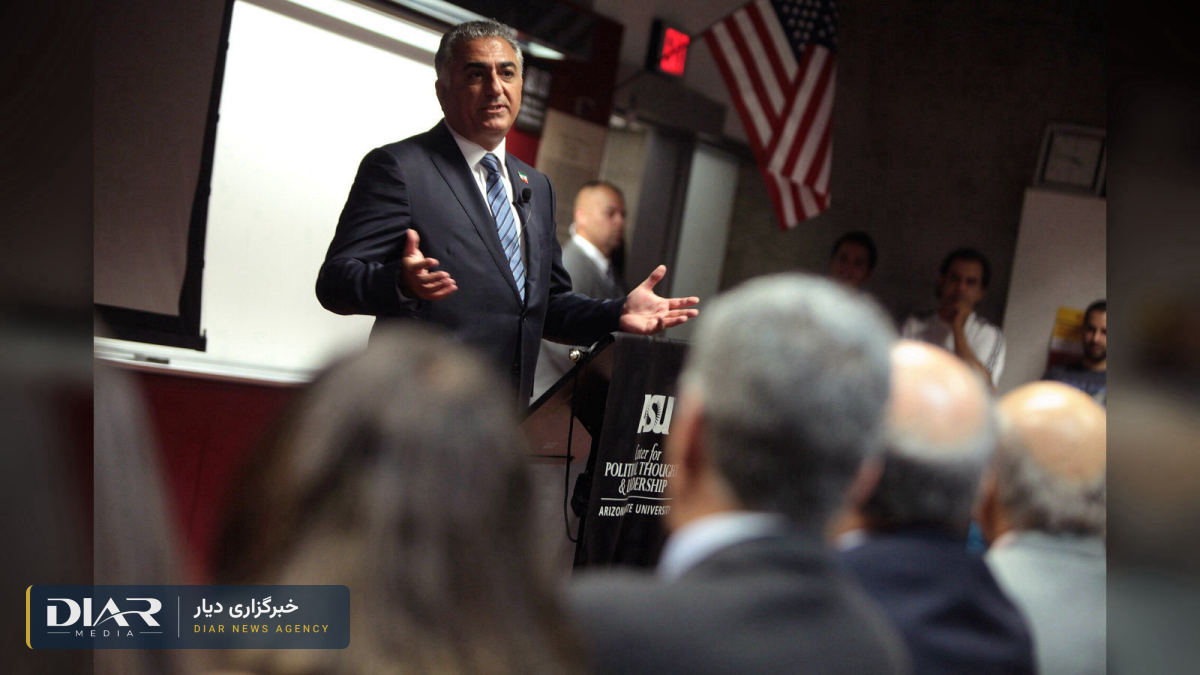
In an op-ed in The Brussels Times on Tuesday, 3 November 2026, as his visit to the Belgian capital began, Prince Reza Pahlavi wrote that Europe's policy towards the Islamic Republic has failed and that EU lawmakers are in a position to change it. Such a change, he wrote, would serve both Iranians and Europeans' own security.
Prince Reza Pahlavi wrote that this week in Brussels he is meeting leaders of several European Parliament political groups and members of the Belgian government and parliament. He recalled that more than a century ago Iranians took Belgium as their model when drafting their first constitution.
The Islamic Republic's threat to Europe
To show that threat, he cited examples from Belgium itself: the conviction of an Islamic Republic diplomat by a court in Antwerp over a bomb plot in France, the hostage-taking of a Belgian aid worker who was later freed in a swap, and a scholar who taught at the VUB in Brussels and has spent a decade on death row in Tehran. The Prince also pointed to networks which, he said, are funded by the Islamic Republic and plot attacks in Germany, France, Italy and Sweden, and to Tehran's support for Russia's war in Ukraine, its nuclear programme, missiles that can reach Europe and its threat to close the Strait of Hormuz.
Prince Reza Pahlavi called the EU's listing of the Islamic Revolutionary Guard Corps (IRGC) as a terrorist organisation the right step, but wrote that Europe's policy towards Tehran is still largely appeasement, and that the Islamic Republic knows it. Europe, he wrote, has been slow to see that this regime is weak, divided and close to collapse.
The Dey uprising and the wave of executions
He recalled that in January millions of Iranians rose up in every province and that, according to him, more than 40,000 people were killed in two nights. The Prince wrote that since then the Islamic Republic has been executing prisoners quietly, one or two at a time and sometimes in public from cranes; according to him, more than 70 political prisoners have been executed since January and more than 100 protesters now face execution. On this very Tuesday two more protesters from the Alikhani Square case in Isfahan were executed, two young men about whom the Prince's office had warned of the risk of execution the day before.
He called negotiating with the Islamic Republic pointless, writing that this regime has lied for 47 years, negotiates only to buy time, and that any agreement lasts only until it is strong enough to break it again.
The Prince's plan and five requests to the European Parliament
Prince Reza Pahlavi described his strategy as follows: building a movement in every town and village, deepening the rifts within the regime and drawing defectors from the security apparatus, uniting Iranians abroad in the broadest possible coalition, and securing practical support from abroad, which he said is the purpose of the Brussels visit. He wrote that this coalition rests on four principles: Iran's territorial integrity, the separation of religion and state, individual rights for all citizens, and the people's right to choose their government in free elections. He also mentioned the Iran Prosperity Project, whose experts are planning for a stable, democratic Iran after the Islamic Republic.
He asked the European Parliament for five steps:
- Applying the Russia sanctions toolkit to the Islamic Republic, including a task force to identify beneficial owners, close front companies and freeze hidden assets.
- Expelling not only diplomats but also IRGC operatives, wealthy relatives of officials and those involved in money laundering, sanctions evasion and intimidation.
- Funding internet tools so that 90 million Iranians stay connected to the world during shutdowns.
- Taking on the political sponsorship of political prisoners, especially the more than 100 protesters who face execution.
- Opening a path for officials who break with the regime and join the people.
Prince Reza Pahlavi asked Europe to stop throwing the Islamic Republic a life raft and, instead of offering sympathy, to act alongside the people of Iran.
The Prince ended his op-ed by saying that no dictatorship can last forever against a united nation. Earlier, in his Abangan message, he had also spoken about the plans for a free Iran.
Comments
No comments yet. Be the first.