
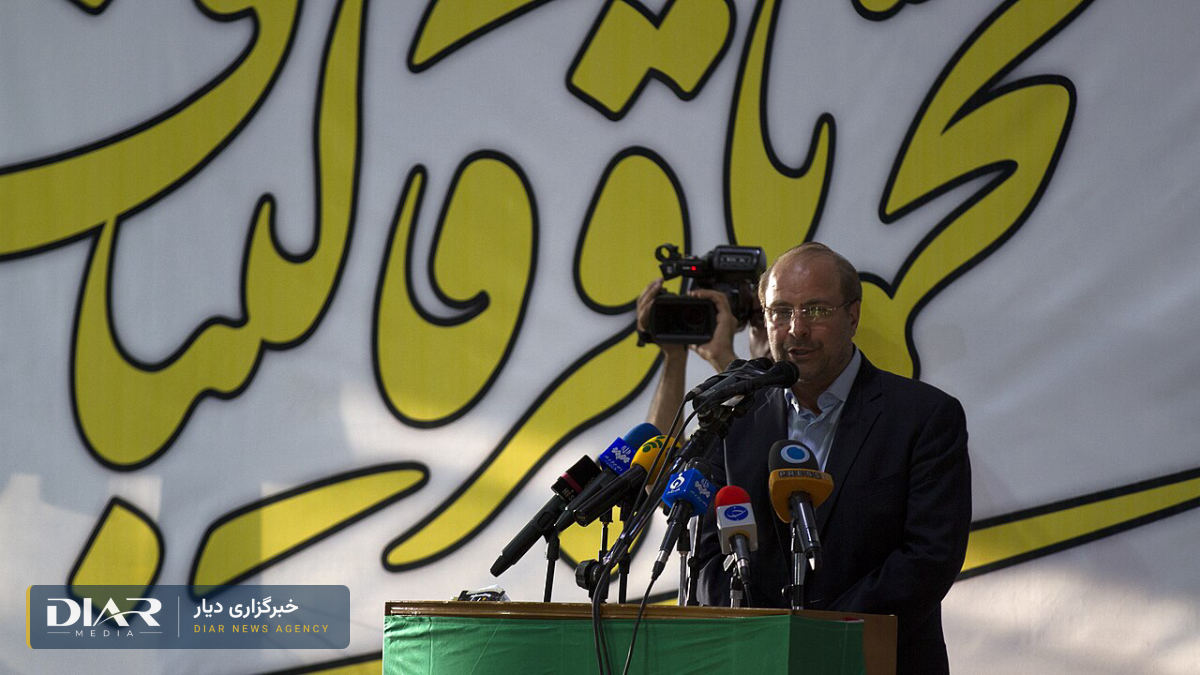
Mohammad Bagher Ghalibaf, speaker of the Islamic Republic's parliament, announced in a message on the social network X on Sunday, 18 October 2026, the launch of a body called the "Persian Gulf Data Organization" and warned governments, investment funds and companies in the region not to provide any resources to AI and data companies that, in his words, play a role in "aggression" and in "killing children".
In the message, Ghalibaf wrote that these companies must not receive financing, shares, land or energy from the countries of the region, and threatened that anyone who helps them will face "executive action" by the Islamic Republic. He named no company and did not explain what structure and powers the body will have, who will run it, or how the Islamic Republic intends to impose its restrictions on companies in other countries.
Threat to data centers and submarine cables
The speaker's message came a few days after Mohsen Rezaei, secretary of the Islamic Republic's Supreme National Security Council, warned that if the United States or Israel resumed their attacks, submarine cables, data centers and AI facilities in the region, which he valued at two trillion dollars, could be targeted. He had said that American technology assets in the UAE and around the Strait of Hormuz were not yet on the target list but might become targets.
The Islamic Revolutionary Guard Corps (IRGC) had earlier, on 31 March 2026, published a list of 18 technology companies, including Microsoft, Google, Meta, Apple, Oracle, Nvidia and the Emirati company G42, accusing them of helping US military operations against the Islamic Republic. These threats have not stayed on paper: in February–March 2026, the Islamic Republic's drones damaged Amazon Web Services data centers; Amazon said two of its facilities in the UAE were directly hit and that an attack near its facilities in Bahrain also damaged infrastructure and caused a service outage.
Hossein Shariatmadari, managing editor of the newspaper Kayhan, also backed Rezaei's warning and called for the submarine cables of the Persian Gulf and the Strait of Hormuz to be used as leverage against Washington. He claimed that damage to these cables would disrupt more than 80 percent of communications, a figure that no independent source has confirmed.
The Persian Gulf, a hub of AI investment
The Arab countries of the Persian Gulf, the UAE in particular, have in recent years become one of the main centers for the expansion of American companies' cloud and AI services. Ghalibaf's threat comes as Islamic Republic officials have hardened their tone toward the United States and the neighbors in recent days, including Mehrdad Akhlaghi, the new defense minister, who threatened American forces, while Israel Katz, Israel's defense minister, has announced readiness to strike the Islamic Republic's energy facilities.
As of publication, none of the Persian Gulf governments, technology companies or US officials has reacted officially to Ghalibaf's message.
After attacking Amazon's data centers, the Islamic Republic is now threatening AI investment across the entire region.
Comments
No comments yet. Be the first.